Chat With Us
+91 99092 37969
How a Rotary Disc Harrow Turns Crop Residue into Natural Fertilizer
Every crop yield produces some crop residues; however, many farmers prefer burning them due to the quick clearance of their fields. While this may seem an easy task, burning the residues results in the depletion of soil nutrients and soil infertility. The best way to handle this situation is to reuse the residues in order to fertilize the soil.
The incorporation of crop residues into the soil by mixing through the rotary disc harrow makes the process easy. Eventually, the crop residues will decompose, resulting in the formation of organic matter, which will improve the nutrient content of the soil.
Why Is Crop Residue Management Important?
Crop residue management involves handling leftover stalks, straw, leaves, and plant material after harvesting. Instead of burning these residues, farmers can incorporate them into the soil, where they decompose naturally and improve soil fertility.
Turn Every Harvest into Tomorrow's Fertility with a Rotary Disc Harrow
A disc harrow is an agricultural implement that is intended for cutting up, mixing, and burying crop residues in the soil post-harvest.
With the mixing of the crop residues with the topsoil, microbes start working and convert the residue into nutrient-containing organic matter.
The system creates a natural circle, as the crop residue, which was a burden before, becomes a source of fertility through decomposition.
Farmers use good quality implements produced by the manufacturer of farm implements and exporter of farm implements - Shree Umiya Agro for making the preparation of the field for the new crop easier.
Why Farmers Are Choosing Residue Incorporation Over Burning
Incorporating crop residue into the soil offers several agronomic and environmental advantages that support healthier fields and more sustainable farming practices.
- How Crop Residue Improves Soil Fertility
Green manure from crop residues occurs when they are incorporated into the soil. The decomposition of these crop residues releases nutrients that promote healthy growth of crops. This leads to improved soil fertility without having to rely on fertilizers externally.
- Why Farmers Are Replacing Crop Burning with Rotary Disc Harrows
Instead of leaving large amounts of stalks and straw on the surface or burning them, the harrow evenly incorporates the residue into the soil. This keeps the field cleaner and prepares it for the next farming operation with minimal effort.
- How Crop Residue Becomes Organic Matter
If the crop residue is integrated well into the soil, then the conditions become perfect for its natural degradation. The organic waste changes into something similar to compost, thereby increasing the nutrients present in the soil.
- Improve Soil Structure with Crop Residue Incorporation
Organic matter plays a vital role in sustaining productivity of the soil. Incorporation of residues from crops into the soil will help in improving soil structure and also improve water retention and aeration properties of the soil. Better soil leads to better crop growth.
- Better Moisture Retention for Healthier Crops
The residue added to the soil makes it able to retain more moisture because it reduces moisture loss from the soil. This is particularly helpful during drought conditions when the crops need moisture.
- Reduce Fertilizer Costs Naturally
As the crop residues break down, they naturally release nutrients like nitrogen, phosphorous, potassium, and organic carbon into the soil. This eventually helps in lowering the quantity of chemical fertilizers needed for maintaining the yields, thus reducing input costs.
- Sustainable Farming Starts with Better Residue Management
Burning crop residues without burning will promote sustainable agriculture practices. The farmers can utilize all the available sources in their farms while minimizing pollution and sustaining soil health for the future generation.
Benefits of Using a Rotary Disc Harrow
A Rotary Disc Harrow offers several advantages beyond field preparation:
- Efficient crop residue incorporation
- Improved soil fertility
- Better seedbed preparation
- Enhanced soil aeration
- Increased moisture conservation
- Reduced residue burning
- Lower dependence on chemical fertilizers
- Improved long-term soil productivity
Which Rotary Disc Harrow Fits Your Farm Best?
Choosing the right tool is based on the size of the farm, compatibility with the tractor, and the needs of the field. This will provide efficiency in the incorporation of the residues in the soil.
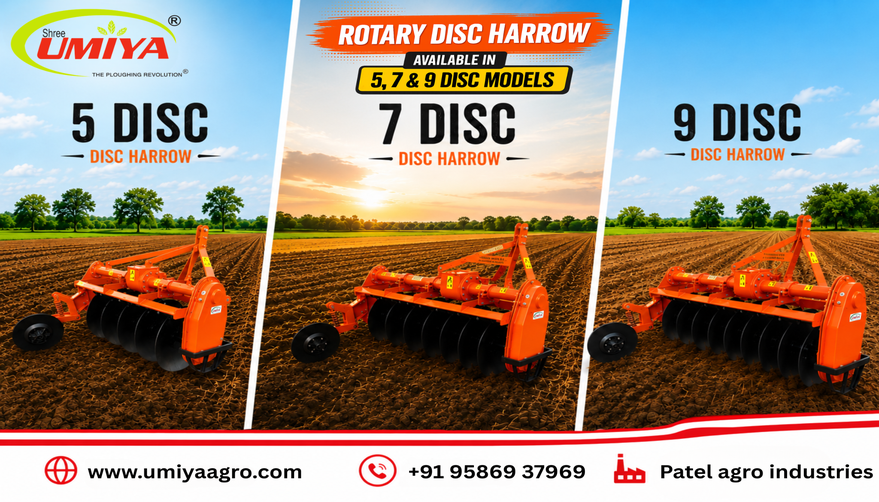
Rotary Disc Harrows come in different forms, and farmers can choose the one which will suit their operations the most.
- 5 Disc Model - Suitable for smaller farms and light field operations.
- 7 Disc Model - Ideal for medium-sized farms requiring balanced performance.
- 9 Disc Model - Designed for larger fields and higher work efficiency.
Choosing the right disc configuration helps achieve better residue mixing while ensuring smooth field preparation.
Get More Value from Every Bit of Crop Residue
Farmers can optimize the advantages offered by crop residues through their immediate incorporation into the soil right after harvesting, maintaining appropriate soil moisture to enhance decomposition, running the harrow at the right depth, and distributing the crop residues evenly on the field.
This will facilitate better organic matter formation and crop residue management.
Conclusion: Transform Every Harvest into Healthier Soil
Not only is crop residue not to be considered as waste, but it can actually be used for creating a valuable fertilizer. With the help of a rotary disc harrow, crop residue is utilized as green manure and helps in creating compost as well. This way of farming is not just beneficial for the present crop but is beneficial for the future as well.
If you're looking for reliable residue management solutions, Shree Umiya Agro is a trusted manufacturer of farm implements and exporter of farm implements offering durable rotary disc harrow models in 5 Disc, 7 Disc, and 9 Disc configurations to meet diverse farming needs. Their equipment is designed to help farmers improve soil health while making field preparation more efficient.
FAQs
Ques
What is a Rotary Disc Harrow used for?
Ans
A Rotary Disc Harrow is used to cut, mix, and incorporate crop residue into the soil while preparing fields for the next crop.
Ques
How does crop residue improve soil fertility?
Ans
As crop residue decomposes, it releases organic matter and nutrients that improve soil structure, moisture retention, and long-term fertility.
Ques
Why should farmers avoid burning crop residue?
Ans
Burning crop residue can reduce soil organic matter and contribute to air pollution. Incorporating residue into the soil supports healthier soil and more sustainable farming practices.
Ques
Which Rotary Disc Harrow is suitable for large farms?
Ans
Larger farms often benefit from higher-capacity models such as 9-disc Rotary Disc Harrows, depending on tractor compatibility and field conditions.
Ques
Why choose a manufacturer of farm implements instead of a trader?
Ans
Working directly with a manufacturer can provide consistent product quality, technical expertise, after-sales support, and access to equipment designed for local farming conditions.

Patel Agro
Farm Implements Manufacturer
As a proud member of the Shree Umiya By Patel Agro Industries team, I'm here to share our expertise & insights of high-quality farm implements like reversible ploughs & tractor operated sprayers. Join us to explore the commitment to quality that define our brand.
Latest Posts
-
July 18, 2026
-

July 16, 2026
-
July 14, 2026